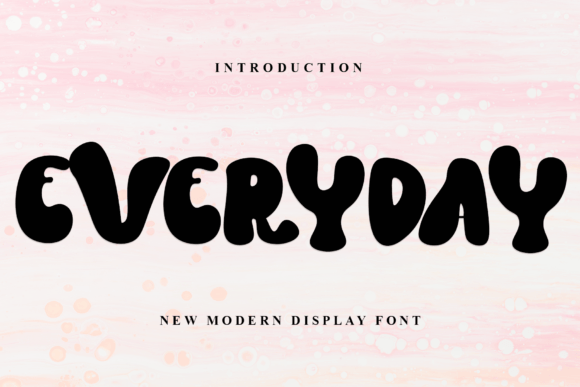
Everyday Display Font for Polished Small Business Branding
I sat down last week to redesign the labels for a new line of hand-poured candles I was preparing for the holiday season, and I hit the same wall I always hit. The product itself was ready—lovely scents, clean ingredients, minimalist glass jars. But the typography on my mockup labels looked flat. Generic. The font I had been using felt stiff and corporate, and it was fighting the warm, laid-back personality I wanted my brand to convey. That is when I pulled up a preview of Everyday, a display font I had bookmarked weeks earlier, and everything clicked.
Everyday is exactly what its name suggests—a charming display font imbued with a sense of freshness and casual elegance. Its fluid strokes and organic lines give it a handcrafted quality that feels approachable without sacrificing polish. For a small business owner like me, that balance is everything. You want your materials to look professional, but you also want them to feel personal. Everyday manages both, and that is rare in a single typeface. The font does not try too hard. It simply makes your designs feel more alive, more intentional, and more connected to the people who pick them up.
How Everyday Gives Product Labels a Fresh, Handcrafted Feel
When I applied Everyday to my candle labels, the difference was immediate. The display font’s organic lines softened the overall look, making the labels feel more like something you would discover at an artisan market than a big-box retailer. The fluid strokes added a sense of movement, which worked beautifully with the hand-poured nature of my product. I used it for the scent names—Vanilla and Cedar, Lavender and Honey—and the typography alone made the jars feel more intentional. Customers do not need to know why a label looks good. They just feel it. And that feeling translates directly into trust and interest.
For a small business selling handmade goods, packaging is often the first physical touchpoint a customer has with your brand. A display font like Everyday helps that first impression feel warm and memorable. It is not trying to shout. It is inviting you in. That casual elegance is especially effective for product labels in categories like skincare, candles, gourmet food, and boutique apparel. If you sell something that benefits from a handcrafted or artisanal aesthetic, Everyday can elevate your packaging without making it look overdesigned. I also tested Everyday on a prototype for a bakery box. The word Cookies set in Everyday looked charming and fresh—the kind of typography that makes someone want to pick up the box and take a closer look. The font works well for short phrases and product names, which is exactly what most small businesses need for labels, tags, and packaging headers.
Using Everyday for Menus, Tags, and Customer Touchpoints
Beyond packaging, I found Everyday incredibly useful for other printed materials that customers interact with regularly. I designed a set of thank-you cards for my candle orders using Everyday for the greeting, paired with a clean sans serif font for the body text. The cards came out looking like something from a specialty stationery shop, not something I printed at home on a standard inkjet. That kind of consistency builds trust. When every piece of collateral feels cohesive, your brand starts to look more established and more reliable.
If you run a café or a small restaurant, Everyday could be a strong choice for menu headers. Its laid-back vibe fits naturally with farm-to-table, rustic, or casual dining concepts. I tested it on a mock menu for a friend's coffee shop, using Everyday for the section titles—Coffee, Pastries, Specials—and it gave the menu a friendly, handwritten feel without losing legibility. That is a key point for any menu: customers need to read the options quickly, and Everyday keeps enough clarity for short display text while still adding personality. It also works well for specials boards, chalkboard-style signage, and takeaway bag stickers.
Boutique owners can also use Everyday for hang tags, price tags, and branding inserts. The font’s organic quality pairs naturally with materials like kraft paper, linen, or recycled cardstock. I designed a simple tag for a clothing boutique concept, and the Everyday lettering made the brand feel approachable yet curated. For small businesses that rely on visual storytelling, these little details matter more than most people realize. A well-chosen display font can turn a plain tag into a keepsake.
Everyday for Social Media Graphics and Online Shop Banners
Typography does not stop at printed materials. Your online presence needs the same level of care, and Everyday holds up beautifully on digital platforms. I used it for Instagram story titles and product announcement graphics, and the font’s casual elegance translated well to mobile screens. It is not overly ornate, so it remains readable even at smaller sizes, which is critical for social media where attention spans are short. A display font that looks good on a label but becomes illegible on a phone screen is not useful for a modern business. Everyday avoids that trap entirely.
For an online shop banner—whether on Etsy, Shopify, or your own website—Everyday can anchor the header with personality. I swapped out a standard script font on a mockup shop banner and replaced it with Everyday. The result felt fresher and more modern. The font does not compete with product photos; it complements them. That is the hallmark of a quality display font: it draws attention without overwhelming the design. If you create digital templates, planners, or printables, Everyday can also serve as a go-to font for titles and decorative accents. Its fluid strokes add a human touch to digital products, which is often exactly what buyers are looking for in a crowded marketplace.
Pairing Everyday with Simple Sans Serif Fonts for Clean Branding
No font works entirely alone, and Everyday shines brightest when paired with a clean, neutral counterpart. In my own branding tests, I paired Everyday with a simple sans serif font for body text—details about ingredients, care instructions, or pricing. The contrast between the organic display font and the clean sans serif created a balanced hierarchy. Customers’ eyes were drawn to the Everyday headlines first, then naturally moved to the supporting information. That visual flow is essential for packaging and marketing materials where you want to guide the reader without making them work for it.
For a more elegant look, you could pair Everyday with a light serif font for a refined editorial feel. Or if you want to lean into the handcrafted aesthetic, a subtle handwritten font for accents can work well—just be careful not to overcrowd the design. The key is to let Everyday lead. Because it has a distinct personality, it works best as the hero of your typography, while simpler fonts handle the supporting roles. When testing font pairings, I recommend printing a sample or viewing it on the actual medium you plan to use. What looks good on screen may read differently on a label, a tag, or a menu. Everyday held up well across all my tests, but it is always smart to preview before committing to a final design.
Everyday Font Licensing and File Formats for Business Projects
Before you download Everyday for your business, take a moment to review what is included in the font package. Most commercial display fonts offer variations like regular, italic, bold, or alternate glyphs. Check whether the version of Everyday you are purchasing includes ligatures and stylistic alternates—these can add even more charm to your designs by creating unique letter connections and flourishes that make your branding feel custom. Also confirm the file formats. You will likely need OTF or TTF files for desktop use, and WOFF or WOFF2 if you plan to use the font on your website for headers or banners.
If you are creating templates for digital products or selling printables, make sure the commercial license covers your intended use. Some font licenses restrict use in merchandise, packaging, or client work, so read the terms carefully. For small business owners, a standard commercial license usually covers product labels, packaging, and marketing materials, but it never hurts to double-check. Multilingual support is another consideration. If your product labels or menus include accented characters or non-English text, verify that Everyday supports the characters you need. A quick look at the font’s character map can save you headaches later. Taking these steps ensures that your investment in a premium display font pays off across every customer touchpoint, from the first online scroll to the unboxing experience.